
 Yahoo Sports
 Rowers lose their senses during races
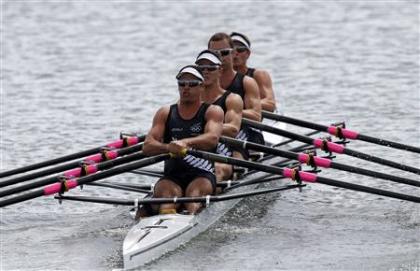
LONDON – Olympic athletes routinely go to extraordinary levels of sacrifice in pursuit of their competitive dreams, but few endure a greater level of suffering than those in the rowing events.
Olympic legend Matthew Pinsent, who retired after winning the last of his four gold medals for Great Britain at the Athens Games in 2004, revealed how it is not uncommon for rowers' senses, such as their hearing and even their vision, to shut down during a race due to the physical side effects of the sport's torturous test of spirit.
"Towards the end, everything starts to go a bit weird," Pinsent said. "It all starts to go. Your senses are not in control anymore and they start to leave you. The hearing will go, the vision goes out of synch, there isn't much left.
"Your body starts to close down anything it doesn't need at that moment. It prioritizes to the parts of the body that are in trouble, like your muscles suffering the agony of the row."
[ Related: Niger rower's painfully slow finish ]
Rowing, known as crew in American high school and college circles, is undoubtedly one of the toughest events of the Olympic Games. Races are held over 2000 meters and have been described as a "six-minute sprint" that leads to huge lactic acid build-up.
Athletes have been known to suffer from memory loss. The sight of an Olympian throwing up over the side of the boat after a race is not uncommon.
Pinsent described how it takes a few moments for the initial pain to set in, but once it does, the remainder of a race is nothing but punishment for the competitors.
"It won't happen in the first few seconds, even sprinting away from the blocks," Pinsent said. "Our body doesn't register the pain problem for 20 seconds and even then it only starts to really burn after 40. The lactate kicks in after about a minute and stays there, tearing at your muscles and mind for the rest of the race.
"The only way to relieve the pain is to stop and that's not going to happen."
Pinsent was the partner of Sir Steven Redgrave for three of his Olympic victories. Redgrave is the five-time gold medalist who ran the final leg of the Olympic torch relay before it was handed to seven young athletes at the Opening Ceremony.
More London Olympics coverage on Yahoo! Sports:
• Badminton tournament marred by teams purposely trying to lose match
• Celtics coach Doc Rivers would be good choice for next Team USA coach
• China's 16-year-old swimming phenom wins second gold amid controversy
